Hotel Management

Hotel Inventory Management: A Practical 2026 Guide for Operations and Procurement

22 July 2026

Overview: What You Need to Know

  • Four steps hold it together: track, order, store, optimise. Get those right and software becomes worth paying for. Skip them and software simply automates a mess.
  • Food waste alone costs the UK hospitality sector around £3.2 billion a year, an average of about £10,000 per outlet (WRAP), and WRAP puts the payback at over £10 saved for every £1 invested.
  • Bathroom amenities are reordered more often than almost anything else, making them one of the best places to win back counting time, storage space and packaging cost.
  • Regulation now shapes stock decisions. Workplace waste separation is law in England, packaging fees are rising, and the EU will phase out miniature hotel toiletries by 2030.

What Is Hotel Inventory Management?

Hotel inventory management is the process of tracking, ordering, storing and optimising every physical item a hotel needs to operate, from shampoo and bed linen to kitchen stock, lightbulbs and crockery, so that nothing runs out and nothing sits unused.

When inventory is well managed, it goes unnoticed, and that is part of what makes it easy to neglect. Stock tends to draw attention only when it runs short, usually when the team is already stretched.

What Poor Inventory Management Costs a Hotel

If you are building the case for investing time or budget, these figures are worth having to hand.

  • Food: UK hospitality outlets discard roughly 920,000 tonnes of food a year, around three-quarters of which could have been eaten. Spoilage accounts for about 21%, the portion stock control addresses most directly (WRAP).
  • Payback: In a study of 42 hotels across 15 countries, over 70% recovered their investment within a year and 95% within two, cutting kitchen food waste by 21% in year one (Champions 12.3, WRI and WRAP).
  • Linen: The Textile Services Association, with UKHospitality and the UK Housekeepers Association, puts hotel losses at more than 12.5 million pieces a year, around 61% of total linen and towelling stock.

Encouragingly, none of this requires a corporate programme. Strattons, a family-run hotel in Norfolk, began weighing and recording every waste stream, lifted recycling to 98% and saved more than £16,000 in a single year (WRAP). Measurement came first, and the decisions about what to change became far easier once the team could see the numbers.

How Inventory Management Works in the Hotel Industry

Every stock system, from a shared spreadsheet to a full software platform, rests on the same four steps. When something goes wrong, it is nearly always in one of these areas:

1. Track

  • Stock locations: List every place stock is kept: main store, floor pantries, trolleys, kitchen dry store, cellar, workshop.
  • Par levels: The amount you hold to cover normal use without running short. In UK laundry practice, PAR means “per available room”: 1 PAR is the linen needed to make up every room once, and rental contracts commonly start at around 5 PAR (Housekeeping Today UK).
  • Counting cycles: Check a portion of stock regularly rather than everything once a quarter. High-value lines weekly, slower movers monthly.
  • Named owners: Each category needs one accountable person, or the count slips.

2. Order

  • Reorder point: The stock level that triggers a new order, set from usage rate and supplier lead time.
  • Lead time: The gap between ordering and receiving. Unpredictable lead times force you to hold more buffer stock, tying up cash and space.
  • Minimum order quantity: The smallest amount a supplier will sell. High minimums on slow movers are a common cause of unused stock.
  • Approvals: Agree who can raise a purchase order, and up to what value.

3. Store

  • Rotation: Oldest stock at the front, newest behind it.
  • Shelf life: Anything dated, whether food, opened cosmetics or cleaning chemicals, should be rotated by date rather than by arrival.
  • Security: Small, portable items do go missing. Store them securely and be clear who holds the key.
  • Condition: Damp stores damage linen and cardboard, so inspect the space, not just the count sheet.

Kitchen storage carries legal weight. Use-by dates relate to safety, and it is an offence to sell food once one has passed, while best-before dates relate to quality (Food Standards Agency). The FSA’s Safer food, better business pack is free and covers stock control.

4. Optimise

Most hotels reach this step last because there is always something more urgent, yet once the first three are steady, the real savings are here. Reduce the number of product lines you carry, consolidate suppliers so you place fewer and larger orders, set par levels against forecast occupancy rather than last year’s habit, and review what you throw away as information rather than waste.

The Hotel Inventory List: What Should You Be Tracking?

Hotel inventory counting works best when everyone is looking at the same list. In many hotels it exists in pieces, spread across a housekeeping spreadsheet, a chef’s order pad and management’s notes. Create one central hotel inventory list and split it by department.

The table below sets out the main categories most hotels track, the sort of items each one covers, and the particular headache each tends to bring. Use it as a checklist to make sure nothing has been missed. 

Category Typical items What makes it tricky
Bathroom and amenities Shampoo, shower gel, soap, lotion, dispensers, slippers, bathrobes Constant replenishment, and guests notice an empty bottle at once
Linen and textiles Bed linen, bath towels, pool and spa linen Always in motion: in use, in the laundry, or in the store
Food and beverage Kitchen ingredients and dry stores, bar and cellar, minibar, breakfast consumables Shelf-life sensitive and legally date-controlled
Housekeeping and cleaning Chemicals, cloths, bin liners, paper goods, tea and coffee Spread across trolleys and pantries, so easily miscounted
Guest-request equipment Cots, rollaway beds, irons, adaptors, wheelchairs Returnable, so they need tracking out and back
Maintenance Spare parts, lightbulbs, batteries, fittings Rarely needed, but costly to be without
Operating equipment Crockery, glassware, cutlery, trays Breakage and loss are continual, so counts drift

Create the inventory list in a document everyone can see, with a column for par level, reorder point, supplier and owner.

Common Hotel Inventory Management Challenges and How to Fix Them

A few common problems come up in hotel after hotel. They are rarely anyone’s fault. Most take hold simply because stock control was never set up properly in the first place, and habits formed around the gaps. The encouraging part is that these problems are usually linked. Get the inventory list and clear ownership in place, and several of them tend to ease at the same time. 

Challenge Why it costs you Fix
Stockouts and overstock Empty shelves affect guests. Full shelves tie up cash and space. Link par levels to forecast occupancy and set explicit reorder points.
Shrinkage and waste Theft, spoilage and expired stock. Spoilage drives a fifth of sector food waste (WRAP). Rotate by date, store valuables securely, count in short cycles.
SKU sprawl SKU means one product line. Too many part-used lines multiply the work. Rationalise the range so every line earns its shelf space.
No clear ownership A spreadsheet on one desktop, no rhythm, no one accountable. Name an owner per category, agree a cadence, then look at software.
Supplier reliability Unpredictable deliveries force larger safety stock. Use suppliers who deliver consistently and consolidate orders.
Departments in isolation Each team counts its own way, so no one sees the picture. One list, one framework, one set of definitions.

Breakfast is a good illustration. Sofitel Bangkok Sukhumvit halved its food waste by value in fifteen weeks with no noticeable change for guests, using measures any kitchen could adopt: cooking some items to order late in service, making less of the dishes that came back uneaten, and giving teams a plan for surplus (Champions 12.3).

Do You Need Hotel Inventory Management Software?

Possibly not, and it is worth answering honestly before anyone signs a contract.

A spreadsheet is perfectly adequate when you have a small independent property, few product lines and one disciplined person who owns the count.

It is time to upgrade when you have several departments ordering separately, more than one property, recurring stockouts, or reporting that needs consumption and supplier data on demand.

What to look for: integration with your property management system and accounting software, mobile counting so housekeeping can log figures where they work, par and reorder automation, supplier management, and reporting. Above all, choose something your team will take to willingly.

Software enforces a good process; it does not create one. Put the list, the par levels and the ownership in place first, and the software will more than earn its keep.

The Rules Shaping Hotel Stock Decisions in 2026

  • Workplace recycling: Since 31 March 2025, English businesses with 10 or more full-time equivalent employees must separate food waste and dry recyclables before collection. Micro-firms have until 31 March 2027 (GOV.UK).

  • Packaging costs: UK producers now fund the full cost of managing household packaging waste, and fees are modulated by recyclability from the scheme’s second year, so harder-to-recycle formats cost more (House of Commons Library).

  • Miniature toiletries in the EU: Under Regulation (EU) 2025/40, small single-use toiletries in the accommodation sector are prohibited from 2030, with most of the regulation applying from 12 August 2026 (EUR-Lex, Council of the EU). Britain has no equivalent ban, and English rules cover items such as single-use plates and cutlery (Business Companion), though groups trading in both markets are largely standardising.

Managing Hotel Bathroom Amenities and Toiletries Stock

Bathroom amenities warrant separate consideration: they are reordered more often than almost anything else, and the work falls to the team with the least spare time.

  • High frequency, high visibility: The items are inexpensive individually, yet the spend accumulates and guests notice an empty bottle at once.
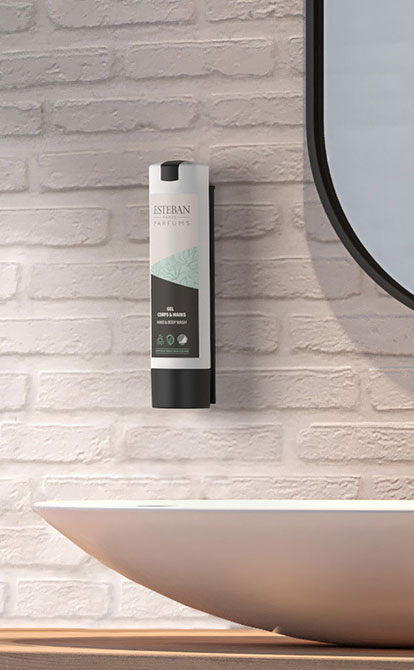
  • Fewer lines mean less work: Moving from single-use bottles to refillable wall-mounted dispensers reduces the number of items to count, store and reorder, giving simpler par levels and less packaging to handle.
  • Refills change the storage maths: One bulk container replaces a stack of bottles, shrinking the storage footprint and slowing the reorder cycle. ADA Cosmetics’ Refillution system refills dispensers from a 10-litre container through a sealed, closed process.
  • A reliable supplier means smaller safety stock: ADA Cosmetics manufactures in Kehl, Germany, warehouses stock in England, and supplies hotels across the UK.

ADA Cosmetics’ hotel toiletries collections are a good place to start, and the hotel plastic waste reduction guide covers packaging in more depth.

Talk to our UK team about simplifying your amenities inventory with refillable dispenser systems.

Frequently Asked Questions

How do hotels manage their inventory?

Hotels manage inventory by tracking stock across departments, setting par levels and reorder points, storing stock so older items are used first, and reviewing consumption against occupancy. Smaller properties do this well with a spreadsheet and a named owner. Larger groups use software linked to the property management system, so ordering triggers automatically.

What are the 4 types of inventory management?

Inventory management has four working stages: tracking (knowing what you hold), ordering (buying the right amount at the right time), storing (keeping stock safe and rotated) and optimising (reducing waste and cost). The phrase sometimes refers instead to the categories of stock a business holds: raw materials, work in progress, finished goods and maintenance supplies. In a hotel, departmental categories work better: amenities, linen, food and beverage, cleaning and maintenance.

What is a par level in a hotel?

A par level is the standard quantity of an item a hotel keeps on hand to meet normal demand without running short. For linen, UK laundry contracts express it as PAR, or per available room, so 1 PAR is the linen needed to make up every room once. Around 5 PAR is common on a rental contract (Housekeeping Today UK). Review par levels against occupancy rather than setting them once.

What is the 80/20 rule in inventory?

The 80/20 rule, or Pareto principle, is the observation that roughly 80% of an outcome comes from around 20% of the causes. Applied to stock, a small share of your product lines accounts for most of your spend. It underpins ABC analysis, sorting items into A (high value, tight control), B (moderate value) and C (low value, simple controls), so attention goes where the money is (CIPS).

What is FIFO, LIFO and FEFO?

Three ways of rotating stock:

  • FIFO (first in, first out): the oldest stock is used first, the default for most hotel stock.
  • LIFO (last in, first out): the newest stock is used first. An accounting convention, unsuitable for anything perishable.
  • FEFO (first expired, first out): stock is used by expiry date rather than arrival date, correct for food and anything with a shelf life, since a newer delivery can carry an earlier date.

For food the dates carry legal weight: it is an offence to sell food after its use-by date, while best-before dates relate to quality (Food Standards Agency).

What is the difference between room inventory and physical inventory in a hotel?

Room inventory is the number of rooms available to sell on a given night. It is perishable, since an unsold room night cannot be sold again, and it sits with the revenue and front-office teams. Physical inventory is the stock on your shelves: amenities, linen, food and spare parts, managed by housekeeping, the kitchen and maintenance.

Occupancy connects the two, which is why par levels set without reference to the forecast tend to be wrong in both directions.

Sources and Further Reading

CONTACT
SHOP NOW

Buy ADA Cosmetics products in our online shop.

REQUEST AN OFFER

For product inquiries worldwide, please contact our sales partners.

CONTACT

For contact inquiries of all kinds, please use our contact form. We will get in touch with you as soon as possible.