With guest expectations higher than ever in 2026, implementing these eight practical changes will help you elevate the daily guest experience and consistently secure those coveted five-star reviews.
1. Audit your guest rooms against your actual 1-star themes
Don’t rely on intuition. Pull your 1- and 2-star reviews from Booking.com, TripAdvisor and Google and look for the words that appear most often. Walk a sample of your rooms against those exact themes.
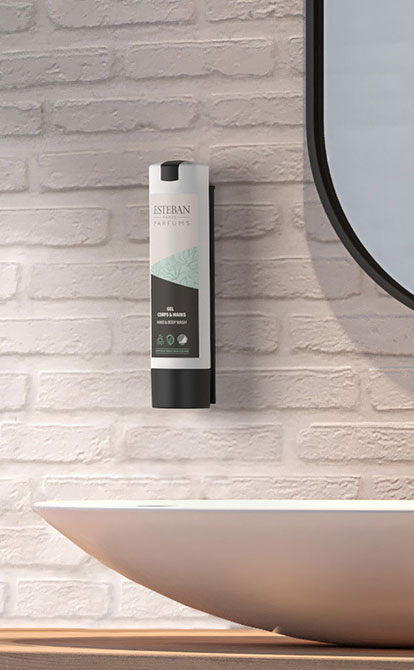
Dispenser-related issues (“empty”, “dirty”, “doesn’t work”) appear as a recurring complaint pattern in hospitality sentiment data. Switching to hygiene-safe, independently validated refillable dispenser systems eliminates an entire category of these complaints. ADA Cosmetics’ Smart Care system, for example, has been validated by Hochschule Rhein-Waal. Validated systems are also increasingly relevant for corporate RFPs, where procurement teams ask for evidence of hygiene standards.
2. Tighten the housekeeping cycle around amenities and consumables
Loose mini-bottles are difficult to audit quickly. Wall-mounted, sealed cartridges with visible fill levels reduce restocking errors and make a low-fill check part of a housekeeper’s normal visual sweep of the room, rather than something that gets missed under time pressure.
3. Train front-line staff for the moments that generate review quotes
Five-star reviews almost always include a specific moment or a named member of staff. Three practices that reliably generate those quotes:
- Addressing guests by name at check-in and during the stay
- Anticipating recurring requests before they’re made
- A quick call during the stay to ask whether everything is comfortable and whether the guest needs anything
4. Ask for the review at the right moment
Post-checkout is the optimal window: within 24 to 48 hours of departure, when the experience is still fresh and the guest is back in their normal routine. Keep the process simple: a single-tap link and a short message. Do not use incentive language, and do not pre-filter who you contact. Keep an audit trail of your process (CMA208 — Fake reviews guidance, April 2025).
5. Respond to every review
Responding to reviews is one of the most consistently supported tactics in hospitality research.
6. Build sub-score discipline
Booking.com and TripAdvisor both publish sub-scores for cleanliness, comfort, location, facilities, staff, and value. These sub-scores are where improvement concentrates fastest, but only if each one has a named internal owner who is accountable for it.
Assign each sub-score to a specific department head and review performance against them quarterly.
7. Use review themes to brief operations
Quarterly reviews of recurring 1- to 3-star complaints should feed directly into operational briefings rather than sit in a spreadsheet. The format that works:
- Pull the most common negative themes from the past 90 days
- Assign each theme to an operational owner
- Set a measurable corrective action with a deadline
- Review whether it’s shifted the sub-score next quarter
8. Make the sustainability story visible in the room
With 65% of travellers saying they want to stay in sustainability-certified properties (Booking), a range of certified amenities gives guests something specific and credible to praise, but only if they can see it. Place the certification mark where guests will notice it. Certifications such as Cradle to Cradle Certified Silver or the Nordic Swan Ecolabel (a Scandinavian environmental certification now recognised across Europe) are verifiable and meaningful to guests who care about this.